We don’t fail at change because of frameworks. We fail because of how we use them.
If you’ve ever been part of a change effort, you’ve probably heard some version of this conversation.
“What framework are we using?”
“Are we following it correctly?”
“Does our checklist align with the methodology?”
All good questions. Until they become the only questions.
Because somewhere along the way, we started treating frameworks like instruction manuals instead of what they actually are: support structures.
A framework is a backbone and not a blueprint.
It gives you the shape, not answers. Direction, not rigidity.
A place to start, not a rulebook to obey.
When we forget that, things start to go sideways.
I’ve seen initiatives succeed using every framework on the chart.
I’ve also seen them fail using those same frameworks, perfectly “by the book.”
The difference was never the model.
It was how alive, flexible, and human it became in the hands of the people using it.
The shift: From rigid methodology to fit-for-humans practice.
Most organizations think they need the right method.
What they actually need is the right translation.
A framework only works when it fits:
-
- the culture people are operating in
-
- the pace they’re already struggling to keep up with
-
- the emotional bandwidth they have left
-
- the moment they’re actually in
Force a rigid process onto a stretched, tired, overloaded team, and even the best framework collapses under its own weight.
Take that same framework, adapt it to the reality of the humans in front of you, and suddenly things move.
Not because the method changed. But because the experience did.
The two wheels of change we rely on.
You’ll see two visuals in this article: a wheel of the “classic six” change methodologies. The other shows five behavioral and emotional models that explain how people actually experience change.
We could’ve listed them out here, but that’s not the point. The point is the relationship between them. The first wheel gives the structure; the second wheel reflects the human reality.
Put them together, and you get a change approach that isn’t just strategic; it’s actually livable.
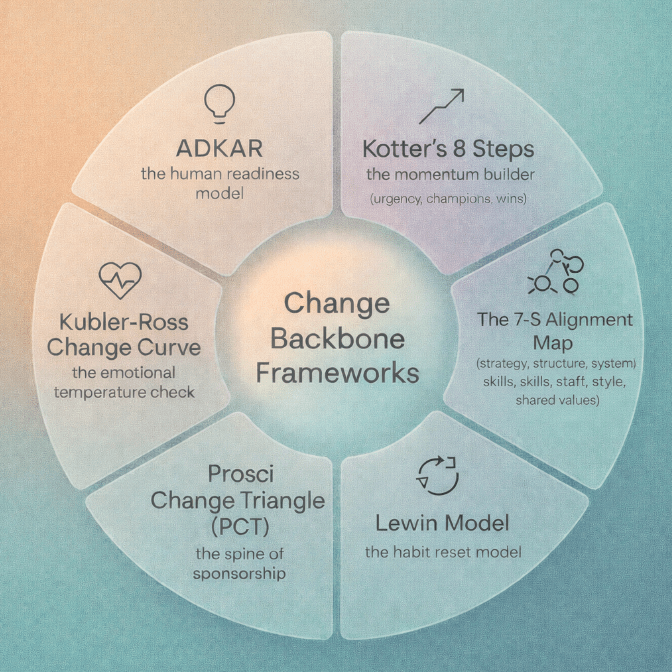
The first wheel: structure without illusion.
These six models give shape to the work. They help organize complexity, create alignment, and prevent chaos.
But shape alone isn’t enough.
Structure without human context becomes brittle.
Precise. Clean. And surprisingly easy to break.
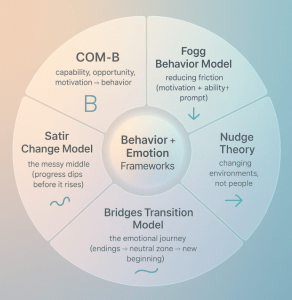
The second wheel: behavior and emotion.
The next five models explain what frameworks alone can’t.
Why people hesitate, why motivation drops, why urgency backfires, why silence isn’t agreement, why “this should be easy” almost never is.
Together, they explain how humans behave during change and how to support that behavior without force, guilt, or endless escalation.
Why customization is the only way change that actually works:
You can’t drop ADKAR into a culture that isn’t ready for honesty.
You can’t run Kotter’s urgency play in an organization already running on fumes.
You can’t point to Kübler-Ross as an excuse for emotional chaos.
You can’t nudge behavior in an environment designed entirely around friction.
But you can tailor any of these models to fit the humans in front of you.
That’s the part organizations often skip.
Frameworks help us organize complexity. But customization helps humans survive it.
A method becomes meaningful only when it becomes yours.
How we bring these models to life:
We don’t use frameworks as templates.
We use them as questions:
-
- How overwhelmed is the team? (Satir, Bridges)
-
- What does each person actually need? (ADKAR)
-
- Where are we misaligned? (7, S)
-
- Do we have the emotional energy for urgency? (Kotter)
-
- Is behavior friction or motivation, based? (COM, B, Fogg)
And then we do the most important part:
We tailor the approach to the humans, not the humans to the approach.
That’s where things start to work. Every time.
What’s coming next in this series:
Think of this article as your map. In future articles, we’ll go deeper, one model at a time and talk about:
You’ll see:
-
- the real moments that surprised us
-
- what didn’t go the way we expected
-
- what the frameworks revealed when we slowed down
-
- and how small adjustments completely changed the outcome
If you’ve ever wondered why change fails even when the strategy is sound, the next articles will help make the invisible visible.
And once you see it, you can’t unsee it.
About The Shift Series
Shift Happens is a series exploring how organizations can turn disruption into direction. We write about the real, human side of work, where change, technology, behavior, and leadership collide in ways no framework fully captures.
Every article follows one of the five currents that shape modern work:
The Human Side of Transformation, the heartbeat beneath the strategy.
Change Management as the Missing Discipline, the discipline hiding in plain sight, quietly determining who succeeds.
Technology, Tools + Human Behavior, the space where logic meets instinct, and where most rollouts live or die.
Organizational Structure, Power & Governance, the lines, ladders, and tensions that decide how work truly flows.
Leadership Micro, Shifts, Governance & Operating Models, the small shifts that create disproportionate impact.
We combine lived experience with practical insight. The kind you can apply the same day, not someday.
Shift happens! But with the right mindset, it happens through you.
If your organization is navigating a shift in technology, structure, or culture and needs practical, human, centered support, reach out.
This is the work we love! And the work we do best.