“Deploy AI” is not a strategy. But in most organizations, it’s being treated like one.
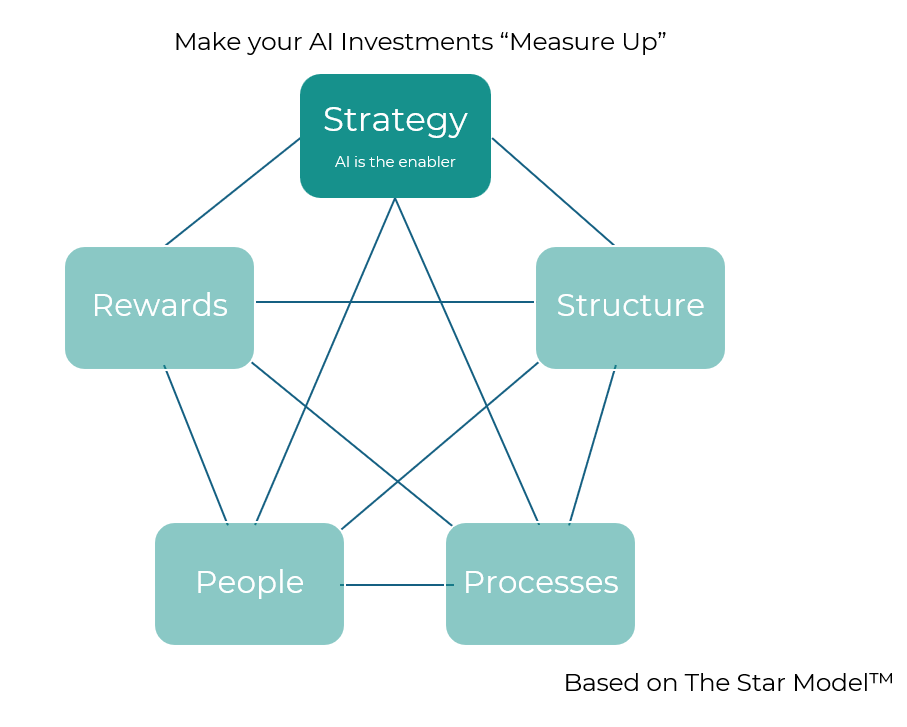
If you read last week’s article, you know the thesis: AI doesn’t fix dysfunction, it multiplies it. The Galbraith Star Model: Strategy, Structure, Processes, Rewards, People, gives us a way to diagnose why. This article focuses on the top of that model: Strategy. Because this is where most AI initiatives go wrong, and they go wrong before a single model is trained.
The Capability-Strategy Confusion
There’s a question I ask early in almost every engagement: What business problem is this AI initiative solving?
The answers are revealing. You hear “efficiency.” You hear “innovation.” You hear “reduce costs.” What you rarely hear is something specific, measurable, and tied to how the organization actually wins in its market.
That’s the gap. AI is a capability. It’s a powerful one. But a capability without strategic direction is just expensive experimentation. When “deploy AI” becomes the plan itself, every team fills the vacuum with their own interpretation. And that’s exactly what happens.
What This Looks Like in Practice
Consider Archer Industries — a specialty building materials manufacturer, with about 6,000 employees. Archer’s competitive advantage was specific: application engineers who worked directly with architects and contractors to solve complex, custom material challenges. Customers paid a premium for that expertise. It was how Archer won.
When the AI mandate hit, the team, under pressure to show quick wins, did what most teams do — they automated the quoting process, deployed a customer service chatbot, and built a demand forecasting model. Reasonable moves. Fast results. None of them connected to what made Archer different.
The quoting system was optimized for speed and standardization — the opposite of Archer’s consultative, engineered-to-order model. The chatbot intercepted the complex inbound calls that had historically led to Archer’s highest-margin custom work. The forecasting model couldn’t distinguish commodity reorders from the custom projects that drove disproportionate profit.
A year and $3 million later, Archer had used AI to get faster at things that didn’t differentiate them while actively degrading the capabilities that did. Core customer satisfaction dropped for the first time in a decade. Two senior application engineers left.
Nobody asked the one question that mattered: what makes us unique, and how should AI amplify that?
What To Do Instead
Start with differentiation, and targeted efficiency. Every AI use case should pass one test: does this create new differentiation, deepen what already makes us different, or does it simply speed up a process?
Use your value proposition as the filter. What if Archer had pointed AI at making their engineers more powerful — surfacing case studies mid-conversation, modeling material performance in real time, identifying cross-sell opportunities from project specs? Same technology. Completely different outcome.
Put the right people in the room. Archer’s use case selection was driven by IT and finance. The people who understood why customers chose Archer weren’t involved until it was too late. The people closest to your differentiation need to shape AI priorities, not just review them.
Measure what matters. Archer tracked quoting speed and chatbot deflection rates. Nobody measured custom project conversion or engineering engagement quality – the things that influence their market position. If your AI metrics do not connect to your differentiation, you’ll optimize toward mediocrity, and call it progress.
The Bottom Line
The most dangerous AI deployments aren’t the ones that fail. They’re the ones that succeed at the wrong things — delivering efficiency while quietly hollowing out what made the organization worth choosing.
The organizations getting the most from AI aren’t moving fastest. They’re the ones who answered the hardest question first: what is our right to win, and how does AI make that stronger?
Does this resonate with you? Unify is here to help. Our consultants are ready to facilitate the right conversations to bring your AI investments into alignment with your strategy.
Next up, we tackle the execution trap and deep dive into an organization where AI surfaced years of informal process deviations, triggering a political crisis over accountability.
About The Shift Series
Shift Happens is a series exploring how organizations can turn disruption into direction. We write about the real, human side of work, where change, technology, behavior, and leadership collide in ways no framework fully captures.
Every article follows one of the five currents that shape modern work:
The Human Side of Transformation, the heartbeat beneath the strategy.
Change Management as the Missing Discipline, the discipline hiding in plain sight, quietly determining who succeeds.
Technology, Tools + Human Behavior, the space where logic meets instinct, and where most rollouts live or die.
Organizational Structure, Power & Governance, the lines, ladders, and tensions that decide how work truly flows.
Leadership Micro, Shifts, Governance & Operating Models, the small shifts that create disproportionate impact.
We combine lived experience with practical insight. The kind you can apply the same day, not someday.
Shift happens! But with the right mindset, it happens through you.
If your organization is navigating a shift in technology, structure, or culture and needs practical, human, centered support, reach out.
This is the work we love! And the work we do best.


